Techniques / Field guide
Five Knife Cuts Every Home Cook Should Know
Good knife work is less about speed than control. Learn to hold the knife properly, protect your guiding hand and practice five basic cuts, and every recipe becomes faster and more even.
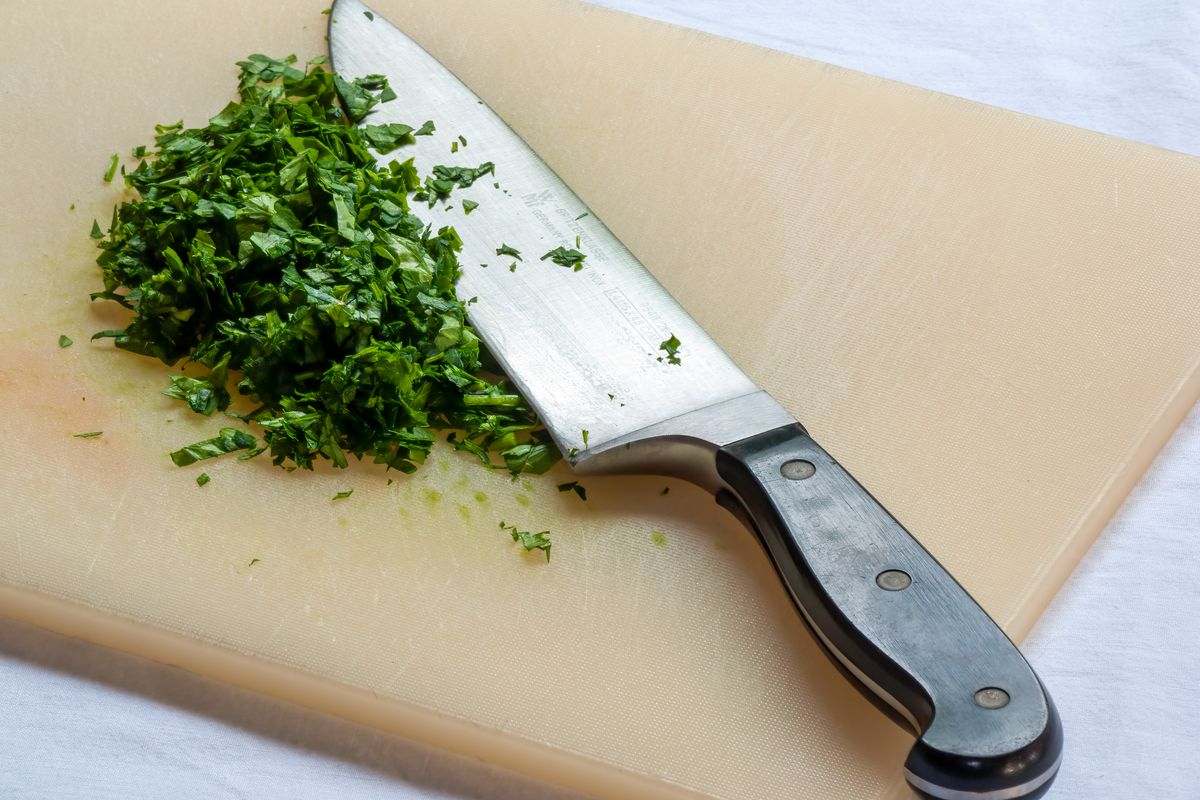
Photo: Messer mit Kräutern und Schneidebrett-20090708-RM-193038 by Ermell, CC BY-SA 4.0, via Wikimedia Commons. Cropped and resized.
Start with the right knife and board
An 8-inch chef's knife does about 90 percent of the work in a home kitchen. It does not need to be expensive, but it must be sharp; a dull knife needs more pressure and is more likely to slip. Set a large wooden or plastic cutting board on a damp towel so it cannot slide.
The grip and the claw
Pinch the blade just in front of the handle between your thumb and the side of your index finger, and wrap the other fingers around the handle. This pinch grip gives far more control than holding the handle alone. With your other hand, form a claw: curl your fingertips under and rest your knuckles against the flat of the blade. The knuckles guide the knife and the fingertips stay out of the way.
1. Slice
Slicing means cutting food into even flat pieces. Use a smooth forward-and-down rocking motion, keeping the tip of the knife on the board. Uniform thickness matters more than thinness, because even slices cook evenly. Practice on carrots, zucchini and onions for French Onion Soup.
2. Dice
A dice is a cube. First square off the vegetable so it sits flat, cut it into planks, stack the planks and cut them into sticks, then cut across the sticks. Small dice is about 1/4 inch, medium about 1/2 inch and large about 3/4 inch. The soffritto in our Winter Minestrone is a fine dice.
3. Mince
Mincing is chopping very finely, usually garlic, shallots, ginger or herbs. Roughly chop first, then rest the fingertips of your guiding hand on the spine of the knife and rock the blade back and forth over the pile, gathering it together now and then. For garlic, a pinch of salt on the board helps you mash it into a paste with the flat of the blade.
4. Julienne
A julienne is a thin matchstick, about 1/8 inch thick and 2 to 3 inches long. Cut the vegetable into thin planks, stack two or three, and slice into thin sticks. It is ideal for carrots, cucumbers, bell peppers and ginger in salads and stir-fries.
5. Chiffonade
Chiffonade is a technique for leafy herbs and greens like basil, mint, sage and kale. Stack the leaves, roll them tightly into a cigar, and slice across the roll into fine ribbons. Use a sharp knife and a single clean stroke to avoid bruising delicate leaves.
Keep your knife sharp
- Hone the blade with a honing steel every few uses to realign the edge
- Sharpen on a whetstone or have it professionally sharpened once or twice a year
- Wash by hand and dry immediately; never put a good knife in the dishwasher
- Store it on a magnetic strip, in a block or with a blade guard, not loose in a drawer
Practice deliberately
Buy an extra bag of onions and carrots and practice one cut at a time, slowly. Speed comes naturally with repetition. Most importantly, keep your attention on the board. If you are distracted, put the knife down.
General cooking information only. Follow food-safety guidance for your area and the instructions for your equipment.